LA Family Wildfire Prep: What Schools Won't Tell You
During the 2024 Palisades Fire, families had 20 minutes to evacuate. Most left without medications, pet carriers, or a plan for where to go. One mother told me: "We'd always talked about making a plan. We just never did."
Here's what schools won't tell you: Their job is campus safety. Your family's safety after pickup—on the freeway, at home, or in a hotel—is 100% on you. And right now, most LA families don't have a plan.
This guide fixes that. In 15 minutes, you'll have clear evacuation triggers, a communication script, and a right-sized go-kit—everything you need for the first 10 minutes of a wildfire evacuation.
Why LA Families Need This Plan
Los Angeles sits in a wildfire corridor. The Woolsey Fire (2018), Bobcat Fire (2020), and Palisades Fire (2024) forced tens of thousands to evacuate—often with less than an hour's notice.
The biggest problems families face:
- Traffic gridlock - Canyons and freeways jam immediately
- Communication failure - Cell towers overload or lose power
- School pickup chaos - Parents don't know if kids were released or where they went
- Decision paralysis - "Should we stay or go?" wastes critical time
This guide gives you pre-made decisions so you're not guessing when smoke fills the sky.
1) Make a "Who Grabs What" Plan
Why this matters: During evacuations, families waste 5-10 minutes running back inside for forgotten items—medications, insurance papers, pet carriers. Some never make it out.
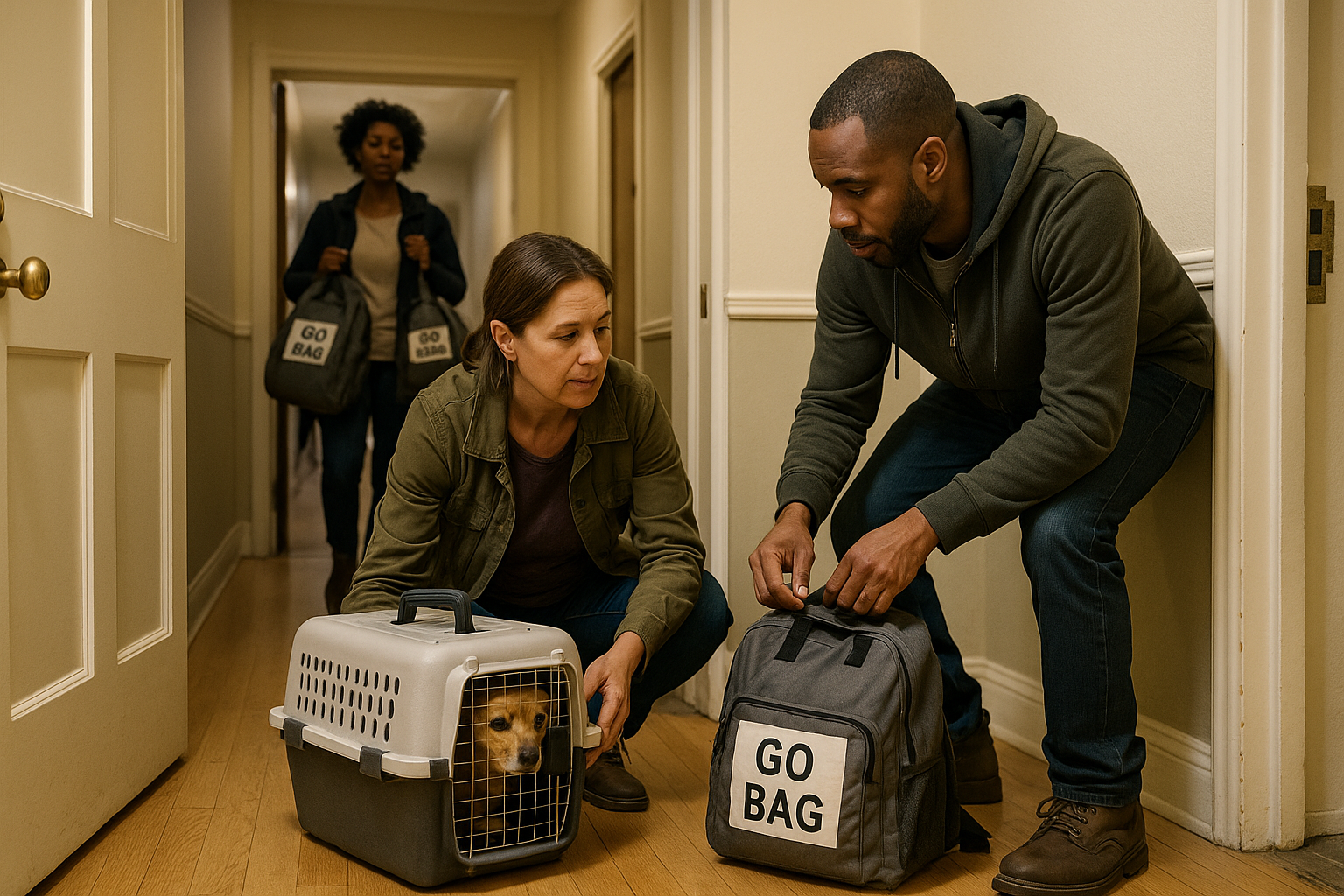
The solution? Pre-assign roles so everyone knows their job in 60 seconds.
Your family roles:
- Adult A: IDs, cash, insurance info, prescriptions
- Adult B: Go-bag, chargers, pet supplies, car keys
- Older kid (8+): Shoes, jacket, personal comfort item, spare glasses
- Younger kid: Snack + water bottle (pre-staged by door)
Keep these in one grab spot by the door. No hunting, no double-backs.
💡 Pro tip: Laminate a "Who Grabs What" card and tape it to the door. When adrenaline hits, you won't remember—but the card will.
2) Set Your Evacuation Triggers (Before Official Alerts Arrive)
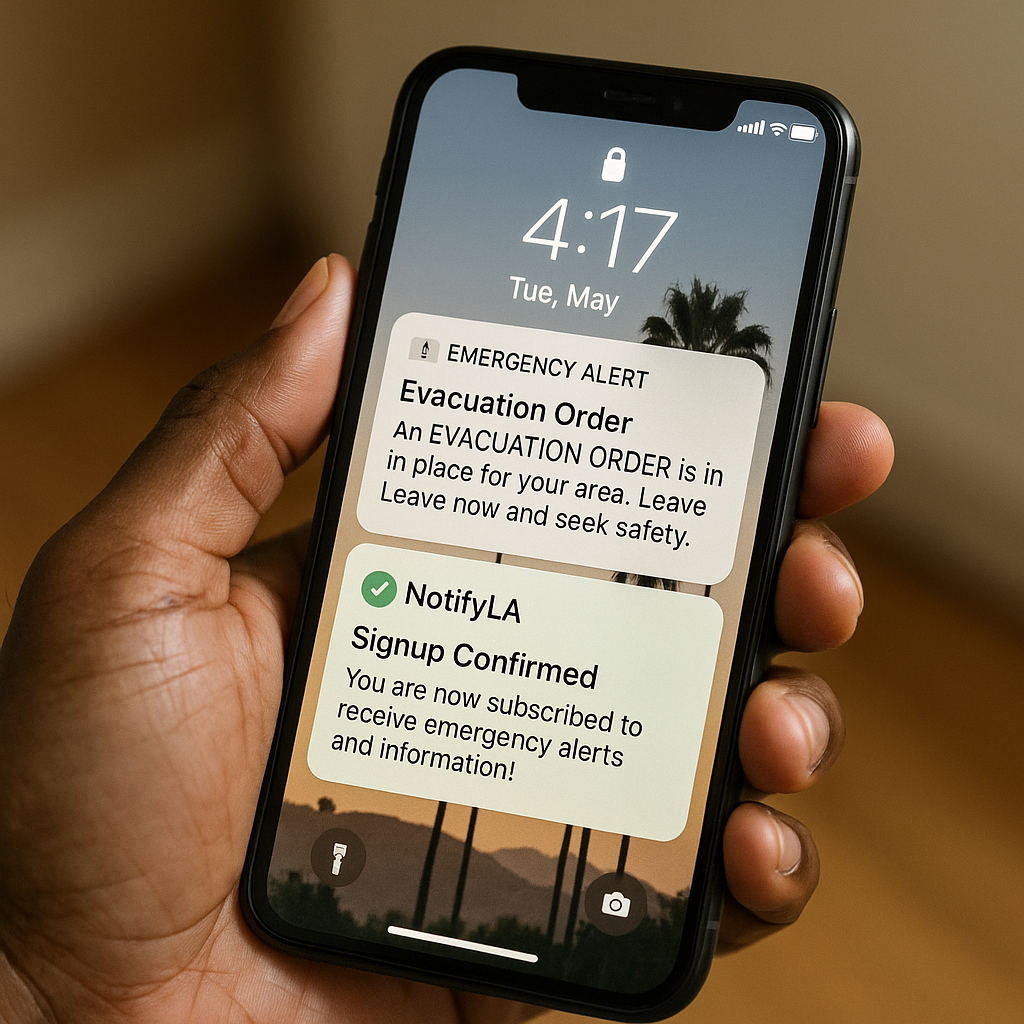
The problem with waiting for official orders: By the time LA County issues a mandatory evacuation, freeways are already jammed. The 405, 101, and PCH become parking lots.
Your family needs two triggers—before things get critical:
🟡 Trigger A (Early Warning):
- Visible smoke in your neighborhood
- Red Flag Warning issued by NWS
- Fire within 10 miles of your zip code
→ Action: Load go-bags in car. Text family group. Monitor Watch Duty app / LA County Fire.

🔴 Trigger B (Leave NOW):
- Ash falling on your street
- Power flickers or goes out
- Neighbors are leaving
- You smell smoke inside your home (even with windows closed)
→ Action: Depart immediately to pre-picked safe address. Do NOT wait for official orders.
Where to go: Pick two destinations in OPPOSITE directions (in case one route is blocked):
- Option 1: Friend/family outside fire zones (West LA, Pasadena, Orange County)
- Option 2: Hotel with confirmed availability (book early during fire season)
Route planning:
- Avoid canyon roads (Topanga, Malibu Canyon, Sepulveda—they bottleneck)
- Have 3 route options: freeway, surface streets, back roads
- Save routes in Google Maps with offline backups
💡 Real example: During the Woolsey Fire, families who left Calabasas at the first sign of smoke made it to safety in 30 minutes. Those who waited for official orders sat in traffic for 3+ hours.
3) Create a 4-Message Family Communication Script
The problem: During wildfires, cell networks overload. Calls don't connect. Group texts fail. Families get separated and panic.
The solution: Pre-write SHORT messages everyone can copy/paste. Texts are more likely to get through than calls.
Your family script (save in Notes app):
Message 1:
"We're safe. Leaving now via [101 South / 405 North]. Headed to [friend's address / hotel name]."
Message 2:
"If separated, meet at: [specific address + cross streets]."
Message 3:
"Check-in schedule: Every hour at :15 (e.g., 2:15, 3:15, 4:15)."
Message 4:
"If no cell service, we'll call [out-of-state contact: Grandma in Ohio / Aunt in Texas]."
Who needs this script:
- All adults in household
- Nanny / babysitter / au pair
- Grandparents who pick up from school
- Older kids (10+) with phones
💡 Pro tip: Practice sending these during a family drill. Kids forget under stress—repetition builds muscle memory.
What about school pickup? If evacuation happens during school hours: Check your school's emergency contact card for the reunification site.
- Schools have their own evacuation protocols—they WON'T release kids to you during active fire
- Kids will be bused to designated safe zones
- Check your school's emergency contact card for the reunification site
- Do NOT drive to the school—you'll block emergency vehicles
4) Your Right-Sized Go-Bag (15 Items, No Overwhelm)
The problem: Most online checklists are overwhelming—50+ items, expensive gear, things you'll never use.
The reality: You need 15 items that fit in ONE tote bag and ONE backpack. That's it.
Your go-bag checklist:
🥤 Immediate needs (1-3 days):
- Water (1 gallon per person)
- Non-perishable snacks (granola bars, nuts, dried fruit)
- Pet food + portable bowl
- Baby wipes (for cleaning without water)
- N95 masks (for smoke—regular masks don't work)
💊 Health & safety:
- Prescription medications (7-day supply)
- Printed medication list (in case bottles get separated)
- First aid kit (Band-Aids, pain reliever, antibiotic ointment)
- Spare glasses / contacts
🔋 Communication & power:
- Phone chargers (wall + car adapters)
- Battery bank (pre-charged)
- Small flashlight (headlamp is better—keeps hands free)
📄 Documents (copies, not originals):
- Photos of IDs (driver's license, passports)
- Insurance cards (health, home/renter, auto)
- Save digital copies to phone + USB drive
🧸 Comfort (don't skip this):
- One comfort item per kid (stuffed animal, book, toy)
- Hoodie or light jacket (hotels are cold)
- Basic toiletries (toothbrush, deodorant, phone charger)
💡 Where to keep it: By the door, not in a closet. You should be able to grab and go in 60 seconds.
What NOT to pack:
- ✅ Cash ($40–$100 in small bills — ATMs may be offline)
- ❌ Irreplaceable photos (scan them; originals stay in fireproof safe)
- ❌ Laptops (too heavy; back up to cloud)
5) Practice Your "First 10 Minutes" Twice a Year
Why drills matter: When smoke is visible and neighbors are panicking, your brain won't work normally. Adrenaline erases memory. You WILL forget things—unless you've practiced.
Your 10-minute family drill (do this twice a year):
Step 1: Set the scene (30 seconds)
"It's 6 PM on a Wednesday. There's smoke visible from our window and ash is falling. We're evacuating NOW."
Step 2: Execute roles (3 minutes)
Adult A: Grabs IDs, cash, insurance, meds
Adult B: Grabs go-bags, chargers, pet supplies, car keys
Kids: Shoes, jackets, comfort items, spare glasses
Step 3: Load car (2 minutes) Put everything in trunk. Everyone buckles up.
Step 4: Send communication script (1 minute) Text the family group and out-of-area contact.
Step 5: Drive to corner and back (4 minutes) Practice your evacuation route. Note: Where does traffic usually jam? Are there alternatives?
Debrief (5 minutes):
What did we forget?
What took too long?
What needs to move closer to the door?
When to drill:
Start of fire season (May)
Before Red Flag Warnings (September-October)
💡 Make it fun: Time yourselves. Set a family record. Give kids jobs that make them feel important (they'll remember better).
Your Next Step (Do This Today)
You now have 80% of what you need. But reading this post won't save your family—implementing it will.
Here's your 15-minute action plan:
- ✅ Right now (2 min): Text your partner: "We need two evacuation destinations. Can we pick them tonight?"
- ✅ Tonight (10 min): Fill in your 4-message communication script and save it in your Notes app. Share with family.
- ✅ This weekend (30 min): Assemble your go-bag. Put it by the door. Run a 10-minute drill.
That's it. Three steps. Your family is ready.
Want help building this faster?
If you'd rather have an expert walk you through this in 90 minutes—with LA-specific routes, triggers, and a custom communication plan—I can help.
I'm Yoni, a former paramedic and CERT-trained coach. I've helped 100+ families build complete emergency plans tailored to their address, kids, and city risks.
Two options:
- Book a free 15-minute Risk Assessment - We'll identify your top 3 risks and decide if deeper coaching makes sense (zero pressure)
- Book a 90-Minute Strategy Session ($179) - Leave with a complete, practiced plan delivered in 72 hours
Or start smaller: Download my free 72-Hour Family Checklist - The 15 items every LA family needs (but most forget)
About the Author
About the Author: Yoni Binstock is a former paramedic with 15+ years of emergency response experience in Los Angeles. He's a member of the LA Community Emergency Response Team (CERT) and has written 10+ books on family emergency preparedness. He's helped 100+ families build custom evacuation plans for wildfires, earthquakes, and power outages.
Get your family ready in one evening
- Download: Free 72-Hour Family Checklist
Book a free 15-min Risk Assessment
Book nowBook a 90-Minute Strategy Session ($179)
Book nowInformation-only coaching. Follow local authorities.